Simulating Probability: How Professionals Test Game Theory
Before the chips are down, the math must hold up. How digital simulations allow us to verify the laws of chance.
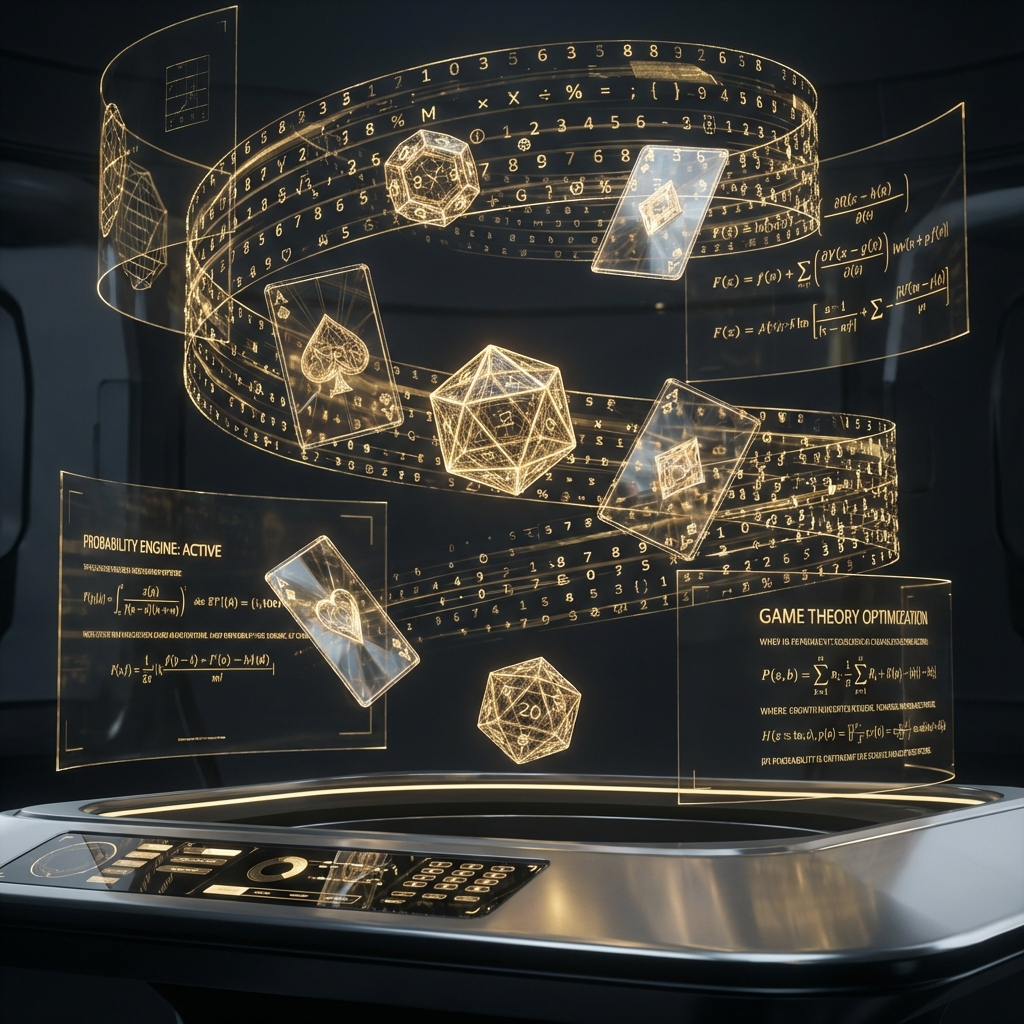
Game theory is elegant on paper, but chaotic in practice. The "Law of Large Numbers" dictates that over enough trials, actual results will converge on the expected mathematical probability. But how do you reach "enough trials" without losing your shirt?
Digital simulation is the answer. By running thousands of automated draws or hands, we can stress-test strategies, verify odds, and understand variance.
The Monte Carlo Method
Named after the famous casino, the Monte Carlo method is a computational algorithm that relies on repeated random sampling to obtain numerical results. It's used in everything from physics to finance, but it finds its purest expression in card games.
If you want to know the probability of drawing a Royal Flush, you can calculate it: 1 in 649,740. Or, you can simulate 10 million hands and count the occurrences. The simulation not only confirms the math but also simulates the experience of variance—the "dry spells" that pure math effectively smooths over.
Pseudo-Random vs. True Random
> Math.random()
Most basic simulations use a pseudo-random number generator (PRNG). For 99% of applications, this is sufficient. However, for high-stakes cryptography or rigorous scientific modeling, PRNGs can exhibit predictable patterns.
Cypherpia utilizes the Web Crypto API, which taps into the underlying operating system's entropy sources (like thermal noise or keystroke timing) to generate randomness that is cryptographically strong. This ensures that our Card Simulator doesn't just "feel" random—it is statistically indistinguishable from physical entropy.
Training with Simulation
Professional card counters and advantage players don't learn in the casino. They learn on simulators.
A tool like our High Precision Cards allows users to deal through a shoe of 6 decks in seconds. This allows a player to practice the "Running Count" and "True Count" conversion hundreds of times an hour, building the neural pathways required for instant calculation at a live table.
Conclusion
Simulation is the bridge between theory and reality. It allows us to fail cheaply so that we can succeed when it matters. Whether you are modeling a financial risk or just trying to beat the house edge, reliable tools are the foundation of success.
Test your theories now on the Vault RNG.