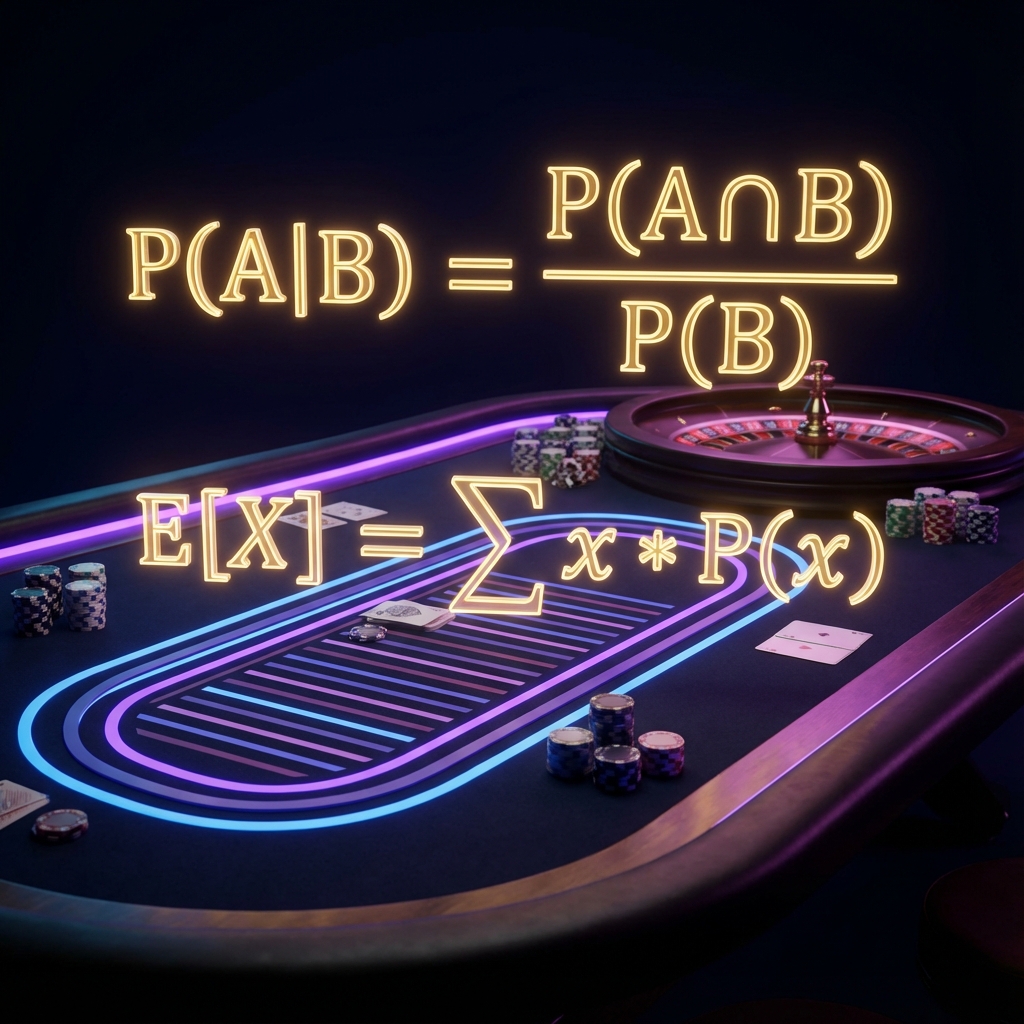
Gambling is often viewed as a game of luck, but beneath the spinning wheels and shuffled cards lies a rigid foundation of unyielding mathematics. Whether you are a casual player or a data enthusiast, understanding the Math of Odds is the single most important step in approaching gaming responsibly and intelligently.
Probability vs. Odds: The Crucial Distinction
In everyday conversation, "probability" and "odds" are used interchangeably, but in mathematics, they mean vastly different things.
Probability is the likelihood of an event happening, expressed as a number between 0 (impossible) and 1 (certain). For example, a fair coin flip has a probability of 0.5 for Heads.
Odds, however, compare the number of ways an event can happen versus the number of ways it cannot.
Example: Rolling a Die
Probability of rolling a 6 is 1/6 (approx 16.6%).
Odds of rolling a 6 are 1 to 5 (1 chance for, 5 chances against).
The House Edge Explained
The "House Edge" is the mathematical advantage that the gambling game, and the commercial gambling venue, has over you as you play over time. This advantage results in an assured percentage return to the venue over time, and for you, an assured percentage loss of what you bet.
Think of Roulette. A European wheel has 37 pockets (numbers 1-36 and a single 0). If you bet on a single number, your probability of winning is 1/37. However, the casino pays you 35 to 1.
If the game were truly "fair" (0% House Edge), the payout would be 36 to 1, perfectly matching the risk. That slight discrepancy—paying 35 instead of 36—is where the casino guarantees its profit.
Common House Edges
- Blackjack (Basic Strategy) ~0.5%
- European Roulette 2.7%
- American Roulette 5.26%
- Slots (Variable) 2% - 15%
Variance: The Short Term Chaos
If the House always has an edge, can players ever win? Absolutely. This is due to variance (or volatility).
The House Edge is a long-term statistical average. Over millions of hands, the math is inevitable. But over a short session—100 spins or 50 hands—anything can happen. You might walk in, hit a jackpot on your first spin, and leave.
High variance games (like Slots or single-number Roulette bets) offer the chance for huge wins but result in long losing streaks. Low variance games (like Betting Red/Black or Baccarat Banker) result in a smoother ride, with smaller wins and losses closer to the expected value.
RTP: Return to Player
RTP is the flip side of House Edge. A game with a 5% House Edge has a 95% RTP. This theoretically means that for every $100 wagered, the game pays back $95.
Important: RTP is calculated over billions of simulations. It does not mean you will get $95 back for every $100 you bet in a single session.
The Law of Large Numbers
This fundamental theorem states that the average of the results obtained from a large number of trials should be close to the expected value and will tend to become closer as more trials are performed.
For a gambler, this law is the enemy. It essentially says: "The longer you play, the closer your results will get to the mathematical prediction (losing)." The only way to "beat" the math is to get lucky in the short term (positive variance) and stop playing.
Conclusion
Mathematics is the language of the universe, and casinos speak it fluently. By understanding the odds, the edge, and variance, you transition from a blind participant to an informed player. Always remember: the math ensures the House wins in the long run, but smart play and discipline govern your personal experience in the short run.