From Bones to Bytes:
The
Evolution of Luck
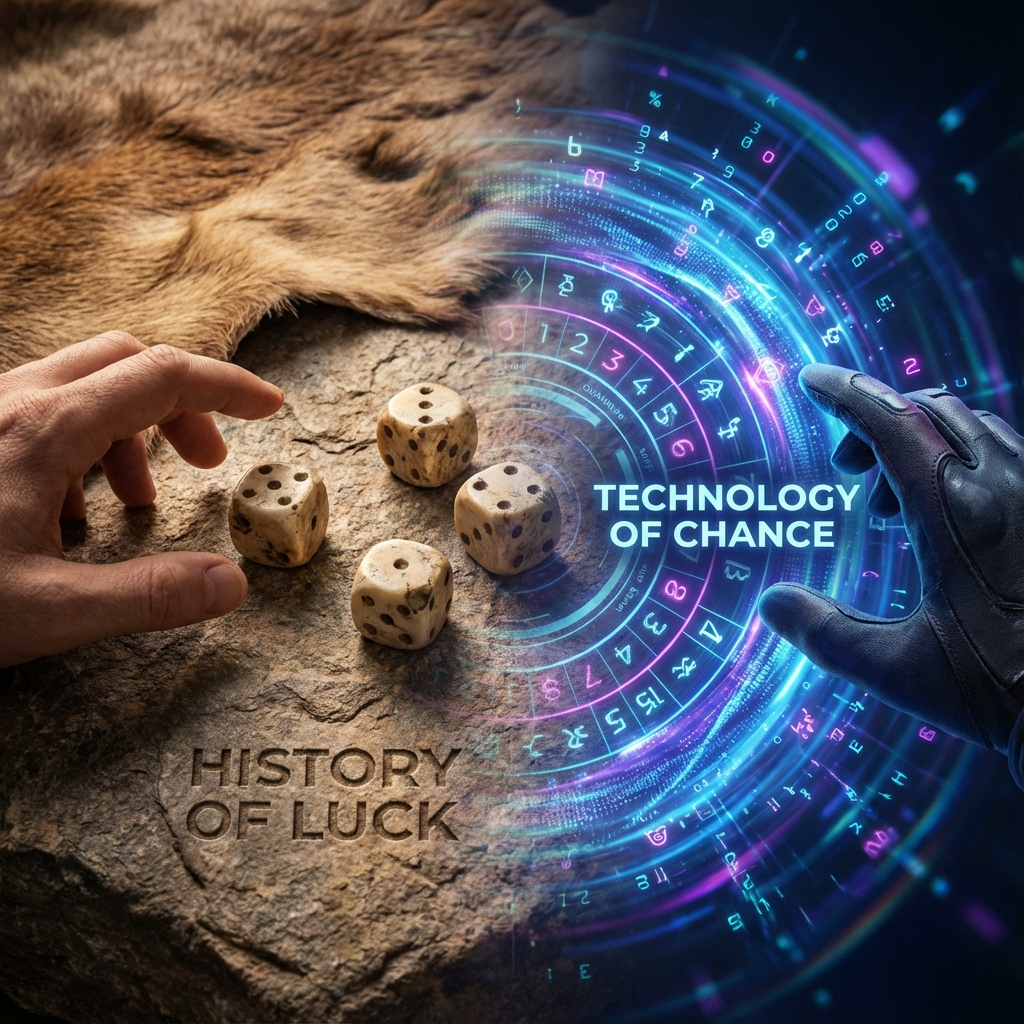
Humanity has always sought to tame uncertainty. For millennia, we cast lots to divine the will of the gods. Today, we cast algorithms to distribute marketing prizes. The tool has changed, but the desire for fairness remains eternal.
The Era of Astragaloi (3000 BCE)
Before the cube, there was the knucklebone. Ancient civilizations used the talus bones of hoofed animals, known as astragaloi, as the first random number generators. They were irregular, biased, and deeply spiritual. A "roll" wasn't just chance; it was a conversation with fate.
The Mechanical Revolution
As manufacturing improved, we standardized luck. The six-sided die (d6) emerged, offering uniform probabilities (1/6). Roulette wheels brought physics into the equation, turning gravity and friction into the arbiters of fortune.
These tools were "fair" only insofar as they were flawless. A chipped die or a tilted table could ruin the integrity of the system.
The Digital Dawn and the PRNG Crisis
With computers came the need for digital randomness. Early attempts were crude. The famous
RANDT algorithm in early mainframes would often repeat patterns after mere thousands of
cycles.
This is the era of Pseudo-Randomness—simulations of chaos that are actually orderly mathematical sequences. Efficient, but vulnerable.
The Future: Quantum and Cryptographic RNG
Today, we stand at the peak of probability technology. Tools like Cypherpia's Vault RNG leverage the chaotic noise of the physical world—captured through hardware interrupts—to feed cryptographic algorithms.
We have returned to the physical world. Just as the ancients relied on the chaotic tumble of a bone, modern computers rely on the chaotic thermal noise of silicon. We have come full circle, but with mathematical proof of fairness that our ancestors could only dream of.